

Welcome to the official Event Page of Torneo di Spada a Rostock.
Here you will get all information you need. Take a look at the timetable, tournament ruleset and equipment required to join the tournament.
There will be German ranked Tournaments in Sidesword (Open/ Woman+) and Rapier (Open/ Woman+)
Date: 28./29.11.2026
Location: An der Jägerbäk 6, 18069 Rostock (Germany)
Participation-Fee: 40 € / 60 € (one day/both days)
Any Questions? You want to join our Judge-Team or help in any other way?
Write us: torneodispada.hro[at]gmail[dot]com
CHRISTMAS SPECIAL
The social event on Saturday (7:00 PM) will be a visit of the Rostock Christmas Fair. Due to the nature of a Christmas Fair no registration is needed. Our Christmas fair is one of the biggest in Germany and our visit will take us through the city. More Info: Rostocker Weihnachtsmarkt (Link)
Ugly christmas sweaters welcome!
To round things off we will celebrate the first advent on Sunday with christmas-themed snacks, drinks and sweets.
During the lunch-break we will hold a sword/fencing-themed „Secret Santa“ („Weihnachtswichteln“ in German). Participants will contribute a sword/fencing-themed gift (DIY or ~5 € – 15 €) and we will distribute them at random between participants.
Time Schedule
TBA after first evaluation of registrations.
Event starts at 9:00 AM on both days. We hope to finish latest 6:00 PM on Sunday.
Rules and Regulations
We use the Bolognese Rules, version 2.1 (English version), as well as the DDHF Framework Rules, version 6.0 (English version). In case of doubt, the Bolognese Rules take precedence.
Rule Adjustments and Clarifications
The following provisions replace rules from the aforementioned documents or provide clarification thereof:
Free (Symmetrical!) Weapon Choice
Free (symmetrical!) weapon choice is permitted, following the example of the Ochsenstich.
“Symmetrical” means that both fencers must agree on the same secondary weapon. Otherwise, the bout is fought with the primary weapon alone.
For the sidesword discipline, the options are:
- Sidesword alone
- Sidesword & buckler
- Sidesword & dagger
For rapier, the following options are available:
- Rapier alone
- Rapier & dagger
Scoring
Variant 1 applies to sidesword and Variant 2 to rapier, as described on page 4 of the Bolognese Rules.
Valid Hits and Safety (Clarification of the DDHF Framework Rules)
Valid hits are hits that make substantial contact with the edge or point. Draw cuts and thrusting cuts must be clearly visible and deliberately targeted.
Examples:
- Hits with the flat of the blade: Not valid.
- Strikes without a proper arc: Not valid.
- Missed thrusts (passé) that make only minimal contact: Not valid.
- Hits that only narrowly pass through a parry due to force, bouncing off, or hyperextension of the wrist: Not valid.
- Any hits made while falling: Not valid.
- Light touches executed with good form and structure because the opponent was left widely open: Valid.
Uncontrolled or dangerous fencing will be penalized with a warning, point deduction, and disqualification if the issue is not adequately addressed.
Examples:
- Hits to the back or back of the head when these could have been avoided.
- Endangering oneself, e.g. by turning one’s back or the back of one’s head toward the opponent.
- Full-power strikes without deceleration.
- Hard strikes, particularly when the opponent is unprotected (e.g. after a wrestling action).
- Simple rule of thumb: If the strike is likely to leave a bruise, it was too hard.
Final Bouts
Only in the final bouts must at least two unharmed exchanges be completed in order to win the bout.
Example: After 5 rounds, both fencers have each scored 2 unharmed exchanges and one double hit. In this case, the points score determines the winner.
However, if after 5 rounds Fencer A has one unharmed exchange and Fencer B has none, additional rounds are fought until one fencer reaches two unharmed exchanges.
Video Review (Final Bouts Only)
In the final bouts, each fencer has the right to appeal a decision by the referees once per bout by requesting video review.
If the appeal is upheld, the referees correct their decision, and the appealing fencer receives another appeal.
If the appeal is rejected, the appealing fencer has no further right to appeal for the remainder of the bout.
- It is the responsibility of the fencers to provide the video evidence. Video may be recorded using mobile phone cameras or similar devices where the footage is directly accessible (smartphones, tablets, etc.).
- Before the bout begins, the fencers must arrange for someone to record the bout. The person recording must not obstruct the referees’ view and must follow any instructions given by the referees and the officials at the table.
- The referees may not request video review themselves unless an appeal has been made. Once an appeal has been made, the referees may, where appropriate, access both videos in order to obtain a neutral view of the situation.
Tournament Equipment
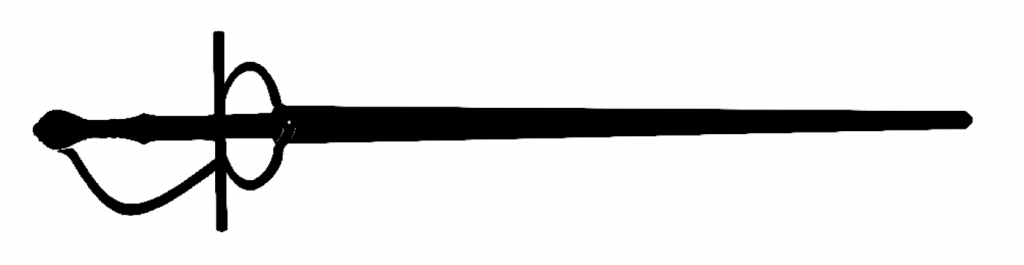
The Sidesword must have the following characteristics:
Sword specifications: Only side swords, Meyer rappiers, or early rapiers are allowed. The number of guard elements follows the standard for side swords (cross, 2 finger rings, knuckle bow, small D-ring on the side) or Meyer rapiers (large D-ring on the side, knuckle bow).
Length of the Crossguard: Must be between 10 cm and 30 cm.
Blade: blunt, 80cm – 95cm length (including ricasso, up to the guard)
Overall length: max. 115cm
Tip: The tip must be additionally secured with a suitable blunt tip protector, with a minimum diameter of 1.5 cm. The material must glide off a fencing mask and must not have sharp edges.
Mass: between 0.9kg and 1.2kg
Bending Behavior: The blade must visibly bend under a test weight of 10 kg.

The Rapier must have the following characteristics
Sword Form: Italian (basket) and Spanish (cup) rapiers are permitted. Thrusts through the basket hilt do not count.
Length of the Crossguard: The length of the crossguard must be between 12 cm and 30 cm.
Blades: Blunt blades, ranging from 95 cm to 130 cm in length (measured to the crossguard). Triangular blades (e.g., Musketeer’s blades) are not permitted.
Total Length: The total length of the weapon must not exceed 140 cm.
Tip: The tip must be additionally secured with a suitable blunt tip protector, with a minimum diameter of 1.5 cm. The material must glide off a fencing mask and must not have sharp edges.
Weight: The total weight of the weapon must be between 0.9 kg and 1.3 kg. Bending Behavior: The blade must visibly bend under a test weight of 7.5 kg.

The Daggers must have the following characteristics:
Dagger Form: For side sword, only daggers with max. 1 D-Ring without a sail / basket (guard) are permitted, while for rapier, both with and without a sail / basket are allowed. Blade catchers on the dagger blade are not permitted. Length of the Crossguard: The length of the crossguard must be between 8 cm and 30 cm.
Blade Length: The length of the blade must not exceed 55 cm.
Total Length: The total length of the weapon must not exceed 70 cm. Tip: The tip must be additionally secured with a suitable blunt tip protector, with a minimum diameter of 1.5 cm. The material must glide off a fencing mask and must not have sharp edges.
Weight: The total weight of the sidearm must be between 0.4 kg and 1.2 kg. Bending Behavior: The blade must visibly bend under a test weight of 7.5 kg.

The Buckler must have the following characteristics:
Diameter: The diameter of the shield’s body must not exceed 42 cm.
Buckler Form: The body must have a circular disc shape and may have a curvature (convex, concave, or both).
Protruding Parts: The edge of the shield may have a raised rim. Other protruding parts, such as knuckle protectors, are not allowed.
Material: The shield must be made of metal or plastic. A combination of different materials (e.g., wood, leather/rawhide, and metal) is not regulated and must be separately approved by the tournament organizers.
Material of the Buckler Handle: The handle can be made of metal, wood, plastic, etc., and does not need to match the material of the shield body.
Fencing mask & rear head protection: a fencing mask FIE standard level 2 with a stab resistance of at least 1600N.

A neck protector made of a hard material that covers the entire larynx and protects the neck from impacts.
(compulsory for women) A chest protector made of a hard material that protects the upper body from blows and stabs.

An upper body protector with a stab resistance of at least 350N, which covers and protects the upper body from the hips to the neck.

A protector made from a hard material that protects the forearm and elbow joint on both arms from impacts.

Gloves made of a hard material that protect fingers and wrist from blows. (min. Red Dragon)

(compulsory for men) A groin guard made of a hard material that protects the genital area from blows.
A thigh protector with a puncture resistance of at least 350N, which protects the thighs from punctures and blows.

Leg protection made of a hard material that protects the knees and shins up to the ankle from impacts.